
Duplicate submissions across brokers: why they happen and how to catch them

 ChatGPT
 Perplexity
 Claude
 Gemini
On this page

TL;DR
- The same account often reaches a carrier or MGA from more than one broker, and brokers also resubmit when they have new loss runs or a corrected application, which is why duplicate submission detection belongs early in intake and clearance.
- Matching on the insured name alone misses repeats filed under a different spelling or a DBA name, which is why it pays to add the FEIN and the policy period to the match.
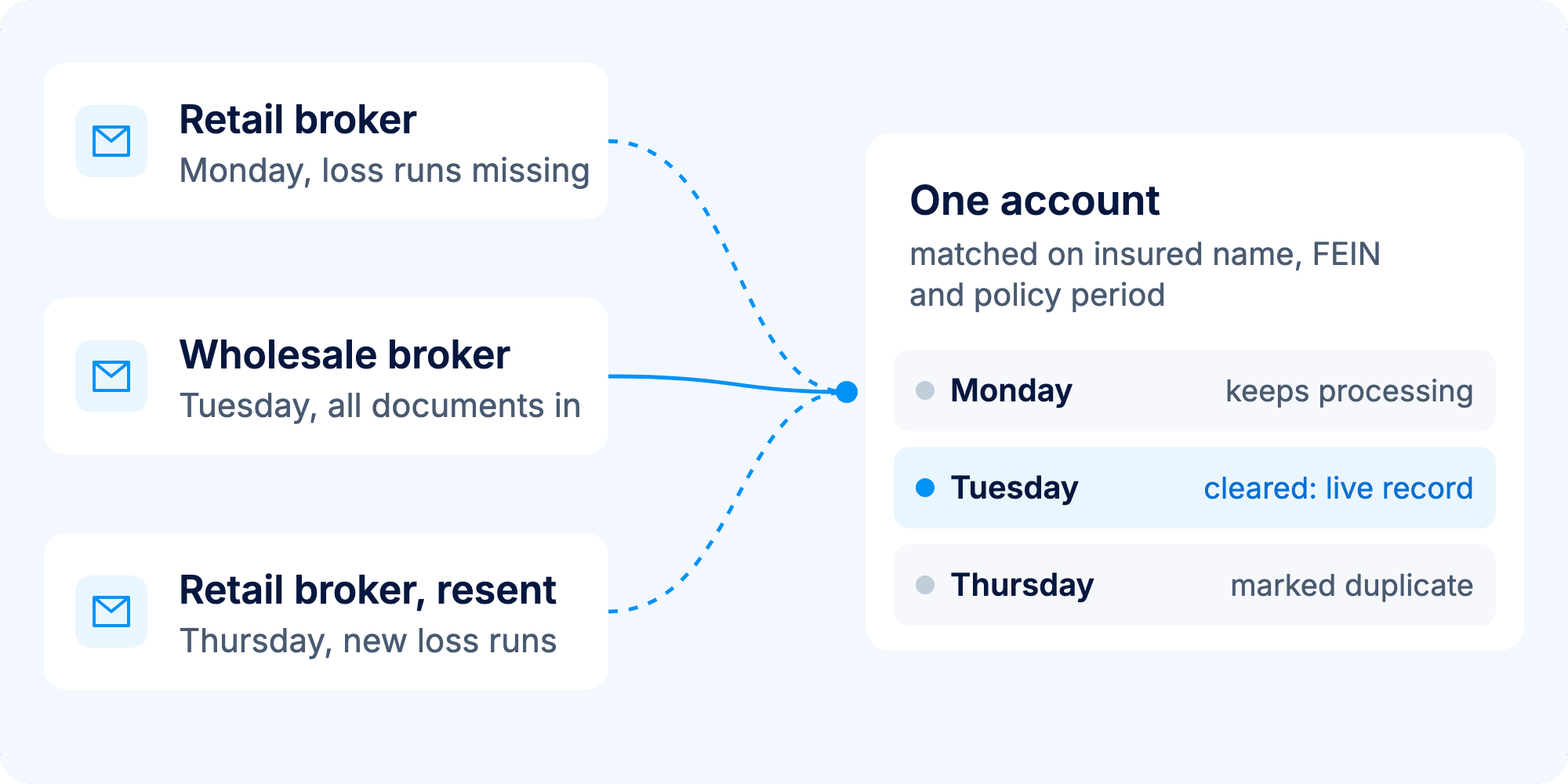
- Unless your market's clearance rules say otherwise, a useful working rule is to keep every version moving through intake until one is complete and cleared, and only then mark the rest as duplicates.
- At Foresight, a workers' compensation MGA, every submission is checked for duplicates from competing brokers before an underwriter reviews it, as one part of a clearance step that averages 30 to 37 minutes.
Duplicate submissions are the same account reaching your submissions inbox more than once, from competing brokers or from one broker resending with new documents, and catching them early is part of submission clearance in the Intake & clearance stage. Catching them before an underwriter opens the file helps keep one person on each account and one answer going back to each broker. This guide covers why the same account arrives more than once, what a missed duplicate costs, and the four checks that catch duplicates without discarding the complete version, and it closes with how duplicate submission detection handles the matching and version rules inside the systems you already use. If you lead intake at a carrier, the two matching checks on account identity and policy period will matter most, while an MGA that works to broker-of-record rules may want to start with the check on keeping every version moving until one clears.
Why does the same account arrive from more than one broker?
In the excess and surplus and specialty markets, an insured's retail broker often shops the account to several markets, and wholesale brokers add another layer, so the same risk can land in your submissions inbox from more than one direction. Brokers also resubmit when they receive new loss runs or a corrected application, which leaves the desk holding versions that differ in small but important ways. As volume grows, each of those versions gets harder to spot by eye, a pressure we looked at in our piece on why E&S submission volume is now a throughput problem. At Foresight, a workers' compensation MGA, the desk clears approximately 4,600 submissions a year, according to the 2026 Foresight case study, and each one is checked for duplicates, alongside completeness and appetite, before an underwriter reviews it.
Further reading: Rising submission volume vs underwriting capacity
What does a missed duplicate cost an underwriting team?
When a duplicate slips through, two underwriters can end up working the same account, quoting it twice or quoting against each other, and the broker sees two answers from one market. Before automation, Foresight's operations team carried this check by hand on every file, alongside appetite and completeness, checking "whether it was a duplicate from another broker" before an underwriter could spend time on the account, as the Foresight case study describes. Duplicate checking is one of several intake checks, and results from automating that wider intake work give a sense of the scale: Kinetic saved 25% of submission review time with loss run automation, according to the Kinetic case study, and in the 2026 CAMICO case study the first phase of rollout lifted throughput per underwriter by 50% and made time to quote new business 15% faster. Manual checks like this also add to the time before the broker hears back, and our analysis of submission turnaround time in commercial P&C looks at how slow intake can cost business.
How do you catch duplicate submissions? Four checks
Four practical checks catch duplicates, and we suggest running them in this order, since each one narrows what the next check has to judge, starting with how you match accounts and ending with what you tell the broker whose version is set aside.
1. Match on more than the insured name
Compare the insured name, the FEIN and the address, because names arrive with different spellings, legal suffixes and DBA names that a name-only match treats as separate accounts; the ACORD 125 application that comes with most submissions includes a FEIN field.
- Expected result: The same account from two brokers is linked even when the names differ
- Watch for: Exact-name matching can miss "LLP" against "L.L.P." and DBA names
2. Check the policy period
A renewal for next year is a separate transaction, while the same coverage for the same policy period arriving from two brokers is a duplicate, so the policy period, read together with the line and layer being asked for, is what separates the two cases.
- Expected result: Renewals stay separate and repeats get flagged
- Watch for: Treating every name and FEIN match as a duplicate, which hides renewals
3. Keep every version moving until one clears
Dropping the second version on arrival is risky, since the second version may be the complete one, so unless your market's clearance rules say otherwise, every version should keep moving through intake, with no underwriter assigned yet, until one is complete and cleared.
- Expected result: The first complete, cleared version becomes the live record
- Watch for: A first-in-wins rule that discards a complete submission in favour of an incomplete one
4. Close the loop with the broker
Tell the broker whose version is not being worked, with the reason, so the broker knows where the account stands and is less likely to send it again.
- Expected result: Brokers know where they stand, which can reduce repeat resubmissions
- Watch for: Silence, which often prompts another resubmission
Go deeper: ACORD 125, Submission intake automation in insurance, Insurance submission workflow improvement: a CUO's guide
Where does software help?
Each of these checks is simple on its own and slow at volume, which is where the Intake & clearance stage of the AI Underwriting OS comes in: duplicate submission detection finds the same account across brokers by insured name, FEIN and other business logic, keeps incomplete versions processing until one clears, and then marks later versions as duplicates automatically. According to the Foresight case study, clearance now averages 30 to 37 minutes and time to quote has come down from 12 days to 2.
Terms in this guide: Submission intake, Submission clearance, ACORD 125, Loss run
Frequently Asked Questions
Is a resubmission from the same broker a duplicate?
A resubmission from the same broker is usually a new version of a submission you already hold when the insured, the FEIN, the coverage and the policy period all match, so keep the history of both versions and fold any valid corrections into the one you work.
Should the first submission received always win?
The first submission received should win only when your own clearance rules say so, because some markets give the account to the first broker that sends a complete submission, and in those markets it helps to keep an early incomplete version processing alongside later ones until one clears. A broker-of-record letter from the insured is a separate process with its own rules.
How does Pibit AI handle duplicate submissions?
The Intake & clearance stage matches the insured name, the FEIN and other business logic you set, keeps every version processing until one is complete and cleared, then marks later versions as duplicates, each with a link back to the original submission so nobody works the same risk twice.
Underwrite in minutes, not days
Here's why: