Submission intake best practices: get the data right before you get it fast




- The core of submission intake best practices is getting the data right first and fast second.
- A tool at 95% field accuracy gets one field in twenty wrong, and a $50,000 misread on a $2M fleet moves that account's loss ratio about 2.5 points.
- The four metrics to track are field-level accuracy, completeness, exception rate and submission-to-quote time, read together.
- A six-point scorecard covers the accuracy guarantee, exception handling, document coverage, PAS integration, auditability and pricing model.
- Pibit AI guarantees 99.9% field-level accuracy with our human-in-the-loop, with a module live in a few weeks.
Submission intake best practices start with getting the data right before you get it fast, because speed wins the quote while accuracy decides whether that quote was priced correctly. Most intake programs optimize for speed and lose accuracy along the way, and the loss ratio pays for it two years later. Submission volume keeps rising while underwriting headcount stays flat, so carriers and MGAs reach for automation at the front door with throughput as the goal, which means clearing more submissions faster. That goal leaves something out, since a submission cleared in minutes still misprices the risk if a loss figure, a classification or a schedule value is wrong. We have written about how fast clearance really needs to be and about what submission intake automation looks like end to end, and this article focuses on the measurement side: the four metrics that show whether intake protects risk selection, and a six-point scorecard to judge any intake tool before you buy.
What does best practice mean for submission intake automation?
Best practice for submission intake automation means every submission reaches the underwriter complete, accurate and ready to rate, with the exceptions governed. Submission intake automation is the layer that reads a broker email and its attachments, checks the submission for completeness and appetite, extracts the data and routes it to the right underwriter, and the measure of success is underwriter-ready data on every submission, more than the number of steps automated.
That framing matters because intake is where risk selection actually begins. The data captured at intake becomes the basis for pricing, so if it is wrong the rate is wrong, however good the downstream model is, and clearance speed remains a real benefit that only pays off once the data holds.
Why does speed-first intake misprice your book?
Speed-first intake misprices risk because it moves bad data faster, and the math is simple: a tool that extracts fields at 95% accuracy gets one field in twenty wrong. On a loss run with hundreds of claim rows, that means dozens of errors on a single account, and one misread paid-loss figure understates exposure so the account looks cleaner than it is.
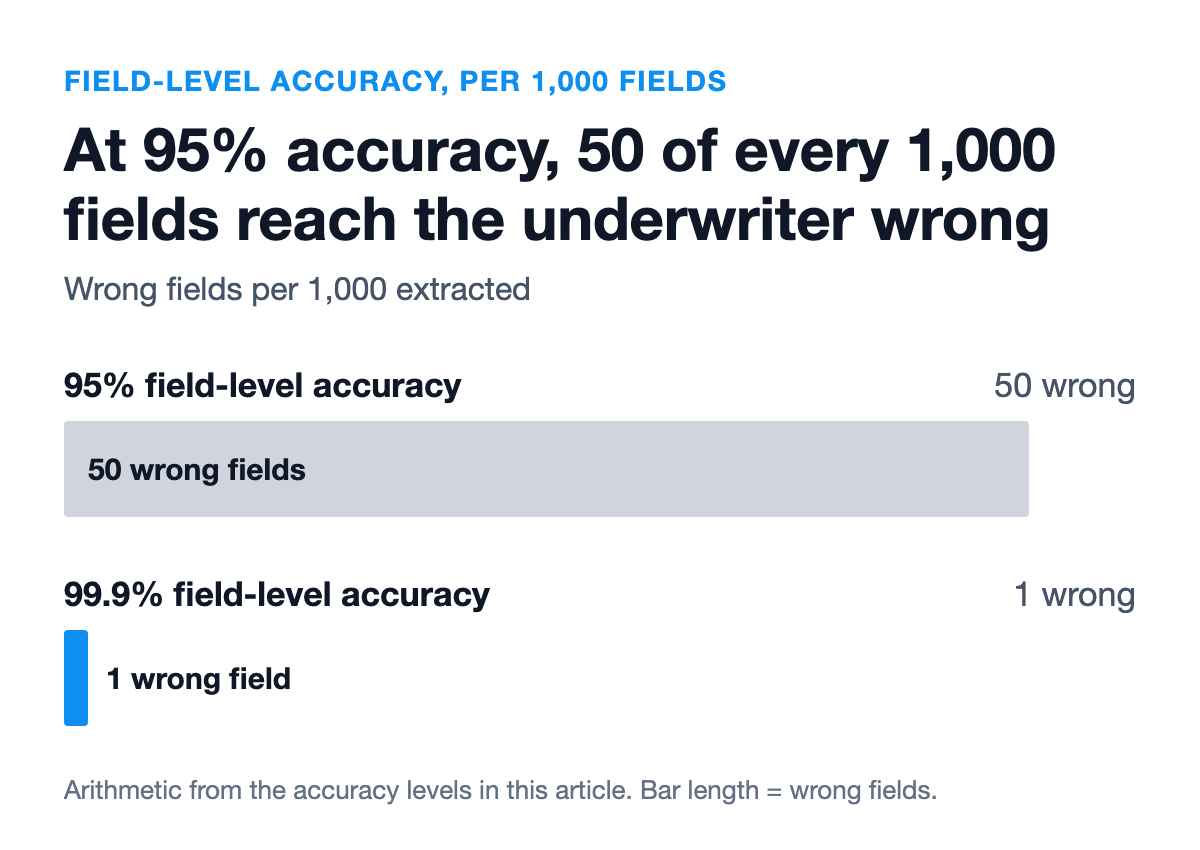
The P&L effect is concrete. A $50,000 misread on a $2M fleet account moves that account's loss ratio about 2.5 points, and when small errors spread across a book, the drift stays invisible until the reserves move, by which time the business is bound and the pricing is set.
Commercial submissions also carry edge cases, such as non-standard loss run formats, handwritten supplements and 200-tab schedules of values, and a system that forces those through without review trades accuracy for a throughput number. The model that works is AI plus expert validation, with only low-confidence fields escalated to a person, and Pibit AI guarantees 99.9% field-level accuracy with our human-in-the-loop, written into the contract.
Which submission intake metrics protect the loss ratio?
The submission intake metrics that protect the loss ratio measure the quality of the data reaching the underwriter as well as the clock, because throughput tells you how many submissions cleared without telling you whether the cleared data was right. Four metrics together show whether intake is protecting risk selection.
| Metric | What it tells you | Best-practice target |
|---|---|---|
| Field-level accuracy | Whether the data that drives pricing is correct | Guaranteed in the contract, beyond a self-reported average |
| Completeness rate | How often a submission arrives ready to be worked on the first pass | Missing documents flagged and chased automatically |
| Exception and escalation rate | How the system handles edge cases it cannot resolve | Low-confidence fields routed to a person |
| Submission-to-quote time | Whether you respond before the broker places it elsewhere | Hours, with accuracy held first |
These metrics work best read together. A fast submission-to-quote time looks good on a dashboard, although paired with a high silent-error rate it becomes a liability, which is why accuracy and completeness are the leading indicators and speed is the one you report once the first two hold.
How should you evaluate a submission intake automation tool?
You should evaluate a submission intake automation tool on the six criteria a mispriced book would expose, since a smooth demo shows clean documents and your inbox rarely looks like that. Score each candidate on how it behaves when the submission is messy, incomplete or non-standard.
| Evaluation criterion | Good: protects risk selection | Risky: moves paper faster |
|---|---|---|
| Accuracy standard | Field-level accuracy guaranteed in the contract | A marketing accuracy number with no penalty behind it |
| Exception handling | Expert validation of low-confidence fields | Every submission auto-cleared with no review |
| Document coverage | Any format, any carrier, without per-template setup | Accuracy drops on non-standard or handwritten forms |
| Integration path | API-first layer on your existing policy admin system | Requires a rip-and-replace or a new system to learn |
| Auditability | Every field traces to its source document | The output is a black box you cannot defend |
| Pricing model | Priced on submissions received, so cost tracks work | Opaque per-document fees that punish messy files |
The most useful test runs each criterion against your own worst submission, with the vendor's sample as a distant second. You can ask to see the tool read a non-standard loss run, and ask what happens to a field the model is unsure about, since the answer to that one question shows whether you are buying risk selection or only speed.
How does submission intake automation fit your existing systems?
Submission intake automation fits best as a layer on your policy admin system, because a tool that demands a rip-and-replace stalls in procurement and never reaches the underwriter. Most carriers run on legacy systems, and an API-first layer reads submissions, returns clean data and writes it into the system the underwriter already uses.
Pibit AI integrates with policy admin systems including Guidewire, Duck Creek and Insurity, and runs headless where a carrier wants no interface change, with a module live in a few weeks. The modular design means a team can start with intake and clearance, then add extraction and research or triage and risk analysis later.
How do you keep AI-assisted intake auditable and defensible?
You keep AI-assisted intake defensible by tracing every field back to the document it came from, which matters more now that regulators have moved on AI. The NAIC adopted a model bulletin on the use of AI by insurers, many states have since followed it, and the bar for testing, governance and transparency has risen, so an intake system that cannot show its work becomes an audit problem.
The answer is field-level provenance. Each extracted value links to the exact page and line it was read from, and the record shows what the AI produced and what a person corrected, which lets an underwriter defend a decision to a regulator, a reinsurer or an internal audit. It also makes the data trustworthy enough that underwriters actually use it, because a tool nobody trusts ends up slower than the manual process it replaced.
What the best-practice model returns
Done well, submission intake automation grows premium without growing headcount, because when clean, complete data reaches the underwriter, their time goes to judgment instead of data entry. Pibit AI customers see 2x underwriter capacity and 70% less time to quote, and CAMICO saw a 20% higher new business hit ratio and 50% more throughput per underwriter. Those results come from accuracy first, governed exceptions and speed layered on top, in that order. If you would like to run the scorecard above against your own submissions, you can request a demo.
Frequently Asked Questions

Get the data right before you get it fast. Track field-level accuracy, completeness and exception rate alongside submission-to-quote time, route low-confidence fields to expert validation, and trace every field to its source document so decisions stay defensible.
It takes weeks when the tool layers on your existing systems, since an API-first layer reads submissions and writes clean data into your policy admin system with no rip-and-replace. Pibit AI integrates with systems including Guidewire, Duck Creek and Insurity, with a module live in a few weeks.
Commercial submissions carry edge cases that need judgment, such as non-standard loss runs, handwritten supplements and large schedules of values. The model that works is AI plus expert validation, where only low-confidence fields go to a person, which is how Pibit AI guarantees 99.9% field-level accuracy with our human-in-the-loop.
Senior Underwriting Operations


Ready to optimize