Intelligent document processing in insurance: what comes after extraction


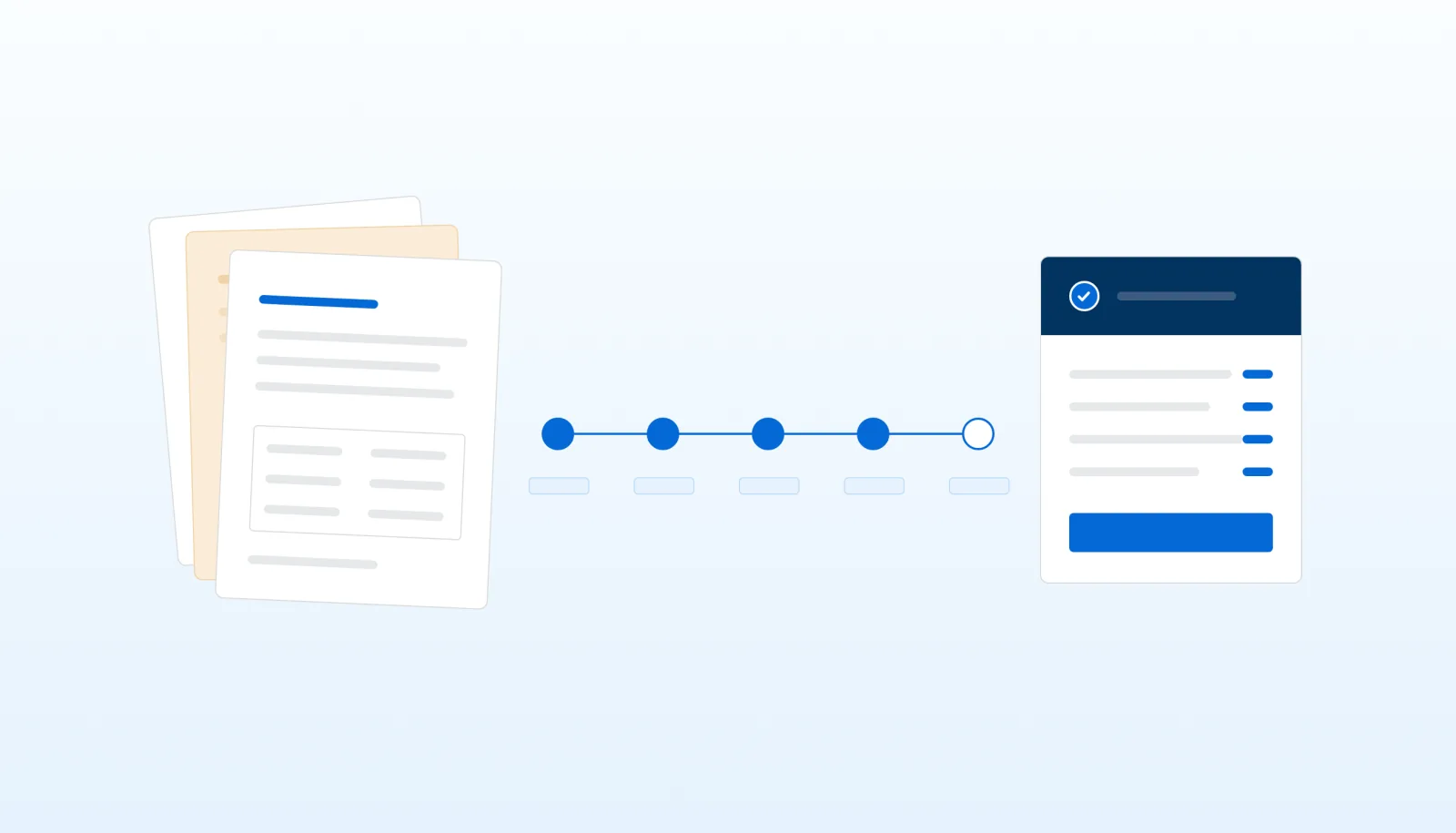

- Intelligent document processing in insurance reads ACORD forms, loss runs and schedules well, and most of the elapsed time now sits in the steps after extraction.
- Completeness checks, broker follow-ups, cross-document checks, clearance and file assembly still fall to people when extraction is the only automated step.
- Autonomy means AI agents carry routine steps from intake to quote while insurance experts govern the result and underwriters keep the decisions.
- Evaluate IDP on your own submissions, on traceability to the source page and on accuracy committed in the contract across the whole workflow.
Intelligent document processing in insurance has done its first job well, because most commercial teams can now turn an ACORD 125, a loss run or a property schedule into structured fields within minutes. The harder question for a chief underwriting officer is what happens after those fields exist. In many carriers and MGAs, a person still decides whether the submission is complete, chases the broker for the missing supplemental, checks clearance, compares the loss run with the application and builds the file the underwriter will read. That work sits between extraction and the quote, and it is where most of the elapsed time and most of the underwriter's frustration live. This piece looks at intelligent document processing through that lens. We ask how much of the path from broker email to quote can run on its own once documents are read correctly, which controls make that safe in commercial, specialty and E&S lines, and what underwriters get back when it works. If you want the definition first, our glossary entry on intelligent document processing (IDP) covers it in detail.
What does intelligent document processing do in an insurance submission?
In a typical commercial submission, intelligent document processing reads every attachment in the broker's email, works out what each document is and pulls the values underwriting needs into a consistent structure. Classification matters more than most buyers expect. A single email can carry an ACORD form, three years of loss runs from different carriers, a statement of values in a spreadsheet nobody formatted the same way twice and a scanned supplemental with handwriting in the margins. We covered the mechanics of that first step in our piece on insurance document classification, and the email side of it in broker email submission extraction. Once documents are classified, a good IDP layer usually handles the following tasks:
- Reading ACORD applications and supplementals, including checkboxes, tables and free-text answers that carry underwriting meaning.
- Normalizing loss runs from different carriers into one view of claims, dates, reserves and payments.
- Turning schedules of locations, vehicles or drivers into rows the rating model and the underwriter can both use.
- Linking every extracted value to the page and line it came from, so a reviewer can check it in one click.
All of this is necessary, and on its own it still leaves the underwriting assistant or the underwriter with a pile of clean fields and a long list of decisions about what to do next.
Where does classic IDP stop in the underwriting workflow?
Classic intelligent document processing stops at the edge of the document, which means the work that depends on comparing documents, applying appetite or contacting the broker falls back to people. A loss run that shows a large open claim the application never mentioned is an ordinary event, as is a schedule whose total insured value does not match the ACORD form or a submission that arrives without a required supplemental. Each one turns into a manual exception queue when extraction is the only automated step. In our experience these exceptions are where turnaround is really lost. Extraction itself takes minutes, while the follow-up email to the broker, the second look at the loss history and the hand-off between assistant and underwriter can stretch over days. We wrote about that gap in our piece on submission turnaround time, and the pattern holds across lines: the more documents a submission carries, the more of its elapsed time sits in the space between reading and deciding.
| Step after documents are read | With extraction-only IDP | With AI agents running the workflow |
|---|---|---|
| Completeness check | An assistant compares the submission with the guidelines by hand | Agents check every required document and field against your guidelines and flag gaps |
| Missing information | Someone drafts and sends a follow-up to the broker, then tracks the reply | Agents draft the broker request for review and attach the reply to the file when it lands |
| Cross-document checks | The underwriter spots conflicts between loss runs, schedules and the application, if there is time | Agents compare values across documents and surface each conflict with its source pages |
| Clearance and appetite | Manual search in the policy admin system and a judgement call on fit | Agents run clearance and score appetite fit, with the reasons shown |
| Underwriter file | Assembled by hand from several screens | Ready to read, with every value traceable to its document |
What does autonomy mean for intelligent document processing in insurance?
Autonomy in this context means AI agents carry a submission through the routine steps from intake to quote on their own, while insurance experts govern the result and underwriters keep every decision that needs judgement. The distinction matters for E&S and specialty buyers in particular, because those risks reward underwriting judgement and almost never fit a rule-only path. The goal is to give underwriters back the hours they currently spend assembling files and chasing brokers. We describe Pibit AI as the AI Underwriting OS for commercial, specialty and E&S insurance because its AI agents run underwriting from submission to quote, which lets underwriters spend their time on decisions and broker relationships. In practice that path runs across six stages, and a carrier or MGA can start with any one of them:
- Intake & clearance, where agents read the email, classify documents and clear the submission.
- Extraction & research, where agents pull every value and add outside information about the account.
- Triage & risk analysis, where agents check appetite and lay out the risk factors with their sources.
- Rating & pricing, where clean, verified inputs feed the rating model.
- Quote & bind, where the quote is prepared for the underwriter's approval.
- Portfolio management, where decisions and outcomes feed back into appetite and pricing.
Accuracy decides how far that autonomy can safely go, which is why our Verified mode commits to 99.9% workflow accuracy with our human-in-the-loop, guaranteed in the contract, with an SLA of two hours at most. We explain how those verified fields reach the underwriter in our piece on underwriter-ready submissions.
How do regulators shape an autonomous document workflow?
Regulators already expect insurers to govern the AI systems that support underwriting decisions, and an autonomous workflow has to produce the evidence that governance needs from the first day it runs. The NAIC adopted its Model Bulletin on the Use of Artificial Intelligence by Insurance Companies in December 2023. According to the NAIC, the bulletin reminds insurers that decisions made or supported by AI must comply with all applicable insurance laws, and it sets out expectations for how insurers govern their use of AI, including the information a department may request during an examination. The NAIC also formed a working group in 2024, now the Third-Party Data and Models Working Group, to develop a framework for third-party AI data and models, which brings vendors such as IDP providers into scope. On the risk management side, the NIST AI Risk Management Framework, released on January 26, 2023 and extended with a generative AI profile on July 26, 2024, gives teams a shared vocabulary for mapping, measuring and managing those risks. For an autonomous document workflow, these expectations translate into a few practical requirements:
- Every extracted value links back to its source document, page and line.
- Every agent action, from a clearance result to a broker request, is logged with a time and a reason.
- Human review points are defined in advance, along with who can override an agent and how that override is recorded.
- The vendor can show how its models are tested and monitored over time on your own documents.
How should carriers and MGAs evaluate intelligent document processing for autonomy?
We suggest evaluating intelligent document processing on your own submissions and on the work that follows extraction. A demo on clean sample files says little about how a tool handles a 40-location schedule or a loss run scanned at an angle. A useful evaluation asks how much of the path to quote runs without a person touching it and how accurate that path is, measured across the whole workflow from intake to quote. Teams that already use a document tool can run the comparison in parallel on one line of business, which keeps the current process in place while the numbers come in. The questions below are the ones we see CUOs and heads of underwriting operations return to most often:
- What happens after extraction? Ask the vendor to walk through a submission with a missing supplemental and a loss run that conflicts with the application, and see which steps still need a person.
- Who owns accuracy? Find out whether accuracy is measured on your documents, whether it is committed in the contract and what review sits behind it.
- Can every value be traced? Click from a field in the underwriter's file to the page it came from, and check that agent actions are logged.
- Does it fit the systems you already run? Confirm it works inside your policy admin system and rating tools, and that you can start with one stage.
- How fast does it go live? With the AI Underwriting OS a module goes live in a few weeks and the full OS in one to two months, with no implementation fee.
For a deeper look at how vendors differ in architecture, our piece on AI-native underwriting compares bolt-on tools with systems designed around AI from the start, and our review of ACORD form processing software covers the extraction layer in more depth.
What do underwriters get back when documents run on their own?
Underwriters get back time for the work only they can do, which is judging risk and building relationships with the brokers who send them business. When AI agents handle reading, checking, chasing and assembling, the underwriter's queue holds submissions that are complete and ready to price, so the first hour of the day goes to decisions. The commercial effect shows up in throughput and speed. The outcomes that show what is possible are 20% higher hit ratio, 2x underwriter throughput and 70% faster time to quote, with each team's result depending on its lines and starting point. Those gains come from the workflow around the documents as much as from extraction itself. We think the next round of IDP buying decisions in commercial, specialty and E&S insurance will turn on how far a submission can travel toward a quote before an underwriter needs to step in, and on whether every step along the way can be checked.
Frequently Asked Questions

Intelligent document processing in insurance is the use of AI to read submission documents such as ACORD applications, supplementals, loss runs and statements of values, classify them and turn their contents into structured data that underwriting systems and underwriters can use. Good IDP also links every extracted value to the page it came from so it can be checked.
Extraction stops once the values are pulled from each document. In an autonomous workflow, AI agents also check completeness against your guidelines, draft broker requests for missing items, compare values across documents, run clearance and assemble the underwriter's file, with insurance experts governing the result and underwriters making every judgement call.
Accuracy needs to hold across the whole workflow, because one wrong value in a schedule or loss run can change a price or an appetite decision. With Pibit AI's Verified mode, the commitment is 99.9% workflow accuracy with our human-in-the-loop, guaranteed in the contract, with an SLA of 2 hours at most.
Founding Member - AI

By submitting this form, you consent to Pibit.AI Inc. contacting you and processing your data in accordance with our Privacy Policy.



Ready to optimize