Underwriting process automation fails when it speeds tasks, not the cycle
.png)


- Underwriting process automation moves turnaround time and the loss ratio only when it compresses the whole submission-to-decision cycle, not single tasks.
- Cycle time is dominated by queues and rework between steps, so speeding an isolated task, faster extraction or a rating macro, leaves the constraint untouched.
- Accuracy is a cycle lever: every misread field is a future rework loop, which is why 99.9% contractual field-level accuracy with a managed human-in-the-loop matters more than raw speed.
- Automation should run high-confidence work and route only exceptions to a human; full straight-through processing forfeits the exception book, where the loss ratio is decided.
- Cleaner intake data compounds into 32% more GWP per underwriter, 85% faster decisions, and up to 700 bps of loss ratio improvement, about $35M on a $500M book.
Underwriting process automation earns its keep only when it compresses the full submission-to-decision cycle. Most carrier and MGA programs speed up isolated tasks, a faster document read here, a rating macro there, then wonder why turnaround time barely moves and the loss ratio does not move at all. The reason is structural. The time and the leakage in commercial underwriting sit in the handoffs between tasks, not inside the tasks. Automate a task and you shave minutes off a step that was never the constraint. Automate the cycle and you change the number a chief underwriting officer is actually measured on.
What is underwriting process automation?
Underwriting process automation is the use of software to run the repeatable steps between a submission arriving and an underwriter reaching a decision: intake, document extraction, data normalization, completeness and appetite checks, risk enrichment, and routing, so a person only touches the parts that need judgment. The operative word is process. A process is a connected chain with a start, a broker email, and an end, a quote, bind, or decline. Automation that does not connect those steps is task automation wearing the process label.
The distinction matters because buyers rarely audit it. A tool that extracts a loss run in two minutes demos beautifully. It also leaves the submission sitting in the same queue, waiting on the same underwriter, bouncing back for the same rework when a field is wrong. The demo measures a task. The P&L measures a cycle.
Why does task-level automation leave turnaround time unchanged?
Because wall-clock time in a submission pipeline is dominated by queue time and rework, not processing time. This is the oldest lesson in operations: a system is only as fast as its constraint, and the constraint in commercial underwriting is almost never the keystroke. It is the wait between steps and the loop back when data is wrong.
Walk one commercial auto submission. The loss run arrives, waits hours in a shared inbox, gets keyed, waits again for a completeness check, comes back missing a driver schedule, triggers a broker follow-up, waits days for the reply, then finally reaches an underwriter. Cutting the keying step from twelve minutes to two changes none of the hours of queue or the days of rework. If a third of submissions require at least one rework loop and each loop adds a day, average cycle time is governed by the rework rate, not by extraction speed. You cannot automate your way out of a rework problem by making the rework faster. You have to stop generating it.

That is why accuracy is a cycle lever, not a quality nicety. Every misread field is a future rework loop. Pibit.AI's argument for 99.9% contractual field-level accuracy, delivered by AI plus a managed human-in-the-loop review team, is not about a benchmark for its own sake. It is about removing the loop that resets the clock. We made the same point about why AI underwriting pilots stall on accuracy rather than on speed.
How do you tell cycle automation from task automation?
Trace one submission end to end and count two things: the human handoffs and the rework loops. If your automation removed a step's minutes but left the handoffs and the loops in place, you bought task automation. If it removed handoffs and loops, you bought cycle automation. The comparison below is the test in practice.
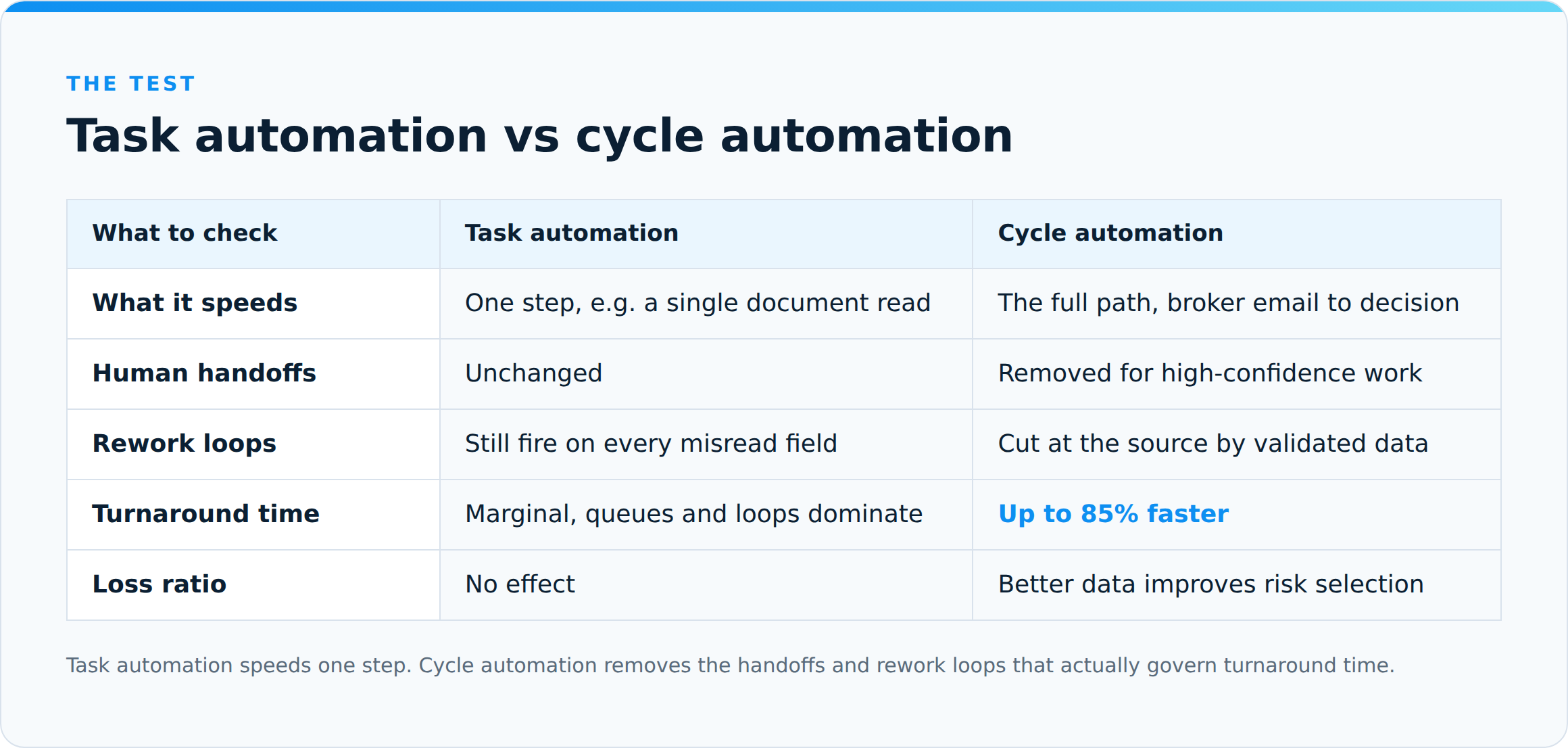
Most disappointment with underwriting automation traces to this confusion. The program speeds the visible, easy-to-demo tasks and leaves the invisible constraint, the queues and the rework, untouched. Turnaround time is a cycle metric, so it responds only to cycle changes. This is the same reason submission turnaround time in commercial P&C rarely improves from a single point tool.
Where should underwriting process automation stop?
At the exception. Automation should run the deterministic, high-confidence work end to end and route only low-confidence, ambiguous items to a human, with the reasons attached. Full straight-through processing on commercial submissions is a mistake, not a milestone, because the exception book is exactly where the loss ratio is won or lost. A clean, in-appetite renewal can move without a human. A first-time construction risk with a thin loss history, a handwritten supplemental, and a coverage gap should not.

This is the honest version of the pitch, and it is also the defensible one. Underwriting decisions have to survive a reinsurer's audit and, increasingly, a regulator's. The NAIC's model framework for insurers' use of AI (2025) pushes carriers toward documented oversight, testing, and transparency in AI-assisted decisions. A system that logs what the AI extracted, what a human changed, and why is auditable by design. One that guesses in the dark is a liability. We treat this as field-level provenance as the audit standard for AI underwriting.
The line between automated and reviewed is not fixed. It moves as models earn trust on a given program and line. But it never disappears, because the point of underwriting is judgment on the hard accounts, not throughput on the easy ones. Automation that respects this line reallocates scarce senior capacity toward the risks that need it. That is the real reason it is an authority problem, not an extraction problem.
What does compressing the cycle do to the loss ratio and GWP?
It moves the only two numbers that matter: capacity and risk selection.
Capacity first. When underwriters stop keying data and chasing rework, senior time redeploys to complex risks and to more submissions per head. In Pibit.AI deployments that shift shows up as 32% more gross written premium per underwriter and 85% faster submission-to-decision, growth that does not require adding headcount into a soft market. That is the same lever behind growing GWP without hiring in a soft market.
Risk selection second, and this is the bigger prize. Accurate, normalized data at the moment of decision reduces adverse selection and mispriced accounts. The math is unforgiving. A $50,000 misread on a $2M fleet moves that account's loss ratio roughly 2.5 points, and misreads do not distribute evenly, they cluster in the messy accounts you most need to price correctly. Across a portfolio, cleaner intake data supports up to a 700 basis point loss ratio improvement in Pibit.AI engagements. On a $500M book, 700 basis points is $35M of underwriting margin. One workers' compensation MGA program running on Pibit.AI processed 1,053 loss runs and 626 submissions in a single month with zero errors, the kind of volume-with-accuracy that makes the capacity and selection gains real rather than theoretical.
The macro stakes are set by the lines under the most pressure. AM Best reports commercial auto has now posted underwriting losses for 14 consecutive years, with 2024 losses reaching $4.9 billion against an eleven-year average near $2.9 billion (AM Best, 2025). When rate alone will not fix a line, the cheapest margin lever left is not writing more of it, it is selecting and pricing it better, which starts with the quality of the data at intake.

How should a carrier sequence underwriting process automation?
Start where the leakage is worst, usually document extraction on loss runs and schedules of values, prove contractual accuracy on live volume, then connect intake, checks, and routing so the cycle closes. A modular path lets a team adopt one step, measure it against turnaround time and rework rate, and expand only once the number moves. That sequencing also de-risks the buy, which matters, because the failure mode for these programs is not technical, it is a stalled pilot that automated a task and never touched the cycle.
The test is not how fast a step runs. It is whether a submission moves from a broker's email to an underwriter's decision with fewer hands and fewer loops. Speed the cycle, and the P&L follows.
Frequently Asked Questions

Underwriting process automation is software that runs the repeatable steps between a submission arriving and a decision being made, intake, document extraction, normalization, completeness and appetite checks, enrichment, and routing, so underwriters only handle work that needs judgment. The test of whether it is true process automation, rather than task automation, is whether it removes human handoffs and rework loops across the cycle, not just minutes from one step.
Only partly, and only if the extracted data is accurate. Extraction speed addresses one step, but turnaround time is governed by queue time and rework between steps. A fast extraction that is wrong creates a rework loop that resets the clock, so accuracy, not raw extraction speed, is what actually compresses the cycle. Pibit.AI's 99.9% contractual field-level accuracy is delivered by AI plus a managed human-in-the-loop review team for this reason.
No. Full straight-through processing forfeits the exception book, the ambiguous, high-severity accounts where the loss ratio is won or lost. The right design runs high-confidence, in-appetite work automatically and routes low-confidence items to a human with the evidence attached, keeping every AI-assisted decision auditable for reinsurers and regulators under frameworks such as the NAIC's model AI governance guidance (2025).
Senior Underwriter



Ready to optimize