Insured data enrichment in underwriting: what to do when the public record disagrees with the submission



- Insured data enrichment in underwriting checks a submission against independent records, such as the state business registry, federal safety data and the insured's own website, before a quote goes out.
- A conflict between the record and the submission should become a visible finding with its source, so the underwriter can ask the broker a precise question and does not have to guess.
- Each entity should come back as validated, doubtful or not found, so that an empty result is always reported and never left as a blank.
- Pulling fresh data on every submission and noting where each finding came from keeps the check current and easy to retrace, and it can run inside the systems a carrier or MGA already uses.
Insured data enrichment in underwriting means checking what a broker submitted against independent records, such as the state business registry, federal safety data and the insured's own website, so that the underwriter can see where the application and the outside world disagree before a quote goes out. The check is easy to describe and slow to do by hand, so a team under a heavy queue tends to save it for the accounts that already look unusual, which leaves the ordinary-looking accounts as the place where a stale entity status or an operation missing from the application can pass unnoticed. This article covers which records are worth pulling, what a conflict between the submission and a record should trigger, and how to keep the process fast enough that it runs on every account.
Which public records are worth checking before you quote?
The useful records are the ones that confirm who the insured is, what the insured does and where it does it, because those three answers decide whether the rest of the file means what it appears to mean. The table below lists common checks in commercial lines, where each record lives and what a mismatch tells the person reading the file. It is a starting list, and the right set varies by class, so a trucking account leans on the federal motor carrier records while a contractor account may lean on workplace inspection history and the company's own project pages.
| What to confirm | Where the record lives | What a mismatch tells the underwriter |
|---|---|---|
| Legal entity and standing | State Secretary of State business registry | The named insured may be dissolved, revoked or registered under another name, which raises the question of which entity the policy would cover. |
| Operating authority and safety record for trucking and transport | Federal motor carrier registration and safety databases | A carrier running under a different authority than the application describes, or a safety record worth reading alongside the loss history. |
| Workplace inspections and citations | OSHA establishment data | Inspection history the application did not mention, in classes where workplace safety matters to the risk. |
| Operations and business description | The insured's own website and public listings | Operations on the site that are missing from the application, or operations in the application that the company no longer advertises. |
| Location details | Address validation and geographic hazard data | An address that does not resolve, or a location in a hazard zone that the schedule does not reflect. |
According to the U.S. Small Business Administration's guide to registering a business, most states require a business to register with the Secretary of State's office, a business bureau or a business agency, and many also require a certificate of good standing from the state of formation, which makes the registry the natural first stop for confirming that the named insured exists and is in good standing. The same guide explains that foreign qualification notifies a state that an out-of-state business is active there, which means one insured can appear in more than one state's registry and that a single search in a single state can return a partial picture.
Public records are also updated on their own schedules. OSHA's data page says the agency collects and maintains a wide range of workplace safety and health data, including inspection and citation data, and that employers, workers and other interested parties may view and download the publicly available data online. The Establishment Search page states the date through which its inspection data runs, a useful reminder that an underwriter reading a record needs to know how current it is as well as what it says.
Why does manual desktop research get skipped on the accounts that need it?
Desktop research gets skipped because the lookups are spread across different sites with different search conventions, and because a hard step often comes after the search, when the underwriter has to decide whether two similar names describe the same business. A registry might list the legal name, the website might use a trade name, and the application might carry a third spelling that the broker typed from memory. Resolving that by hand takes judgment and time, and under a heavy submission queue the sensible response from a busy underwriter is to spend that time on the accounts that already raise a question, which leaves the quiet accounts with the least scrutiny. In our view, that pattern is the main reason enrichment belongs in the workflow itself, running on every submission as it arrives, because a check that depends on someone finding spare time tends to be applied unevenly.
The earlier piece on external data and account intelligence describes the visibility gap that opens when a submission shows only what the applicant chose to include. This piece picks up the next question, which is what the system and the underwriter should do once the outside record is on the table and it does not match.
What should happen when the public record disagrees with the submission?
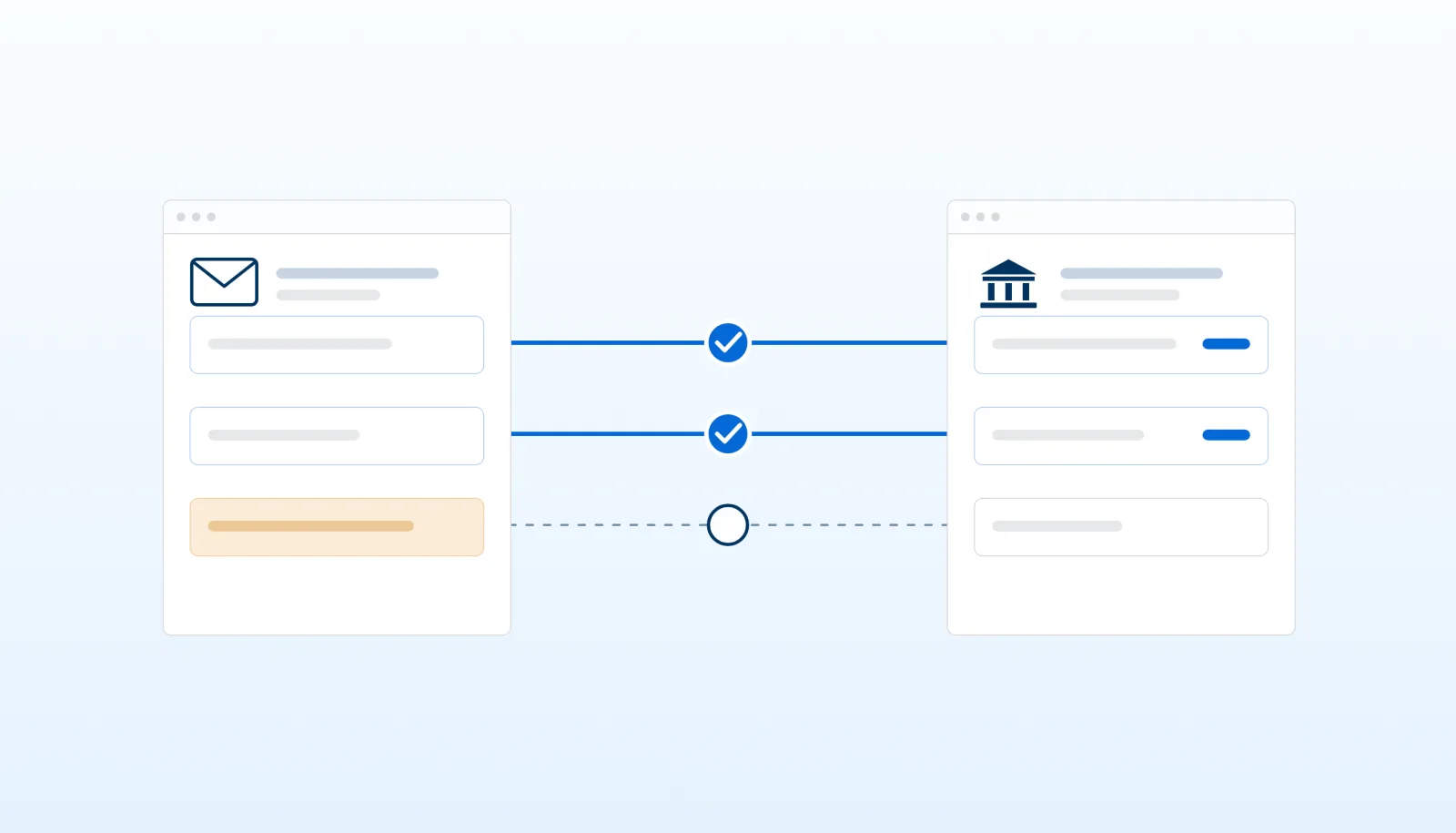
A conflict should become a visible finding with its source attached, and it should never silently overwrite what the broker submitted. The application remains the document that says what the insured is asking to be covered for, so a mismatch works best as a prompt for a question to the broker, for example whether the second location on the website is missing from the schedule or whether the dissolved entity in the registry is a predecessor of the named insured. Pibit AI's Extraction & research stage is built around this idea: it confirms an entity's legal standing, including active, dissolved, revoked or inactive, with registration dates attached to the finding, and it works out which DBAs and related companies belong to the same insured by matching on several signals together rather than on the name alone. Each entity comes back as validated, doubtful or not found, and in practice the three states tend to mean the following for the underwriter.
- Validated means the sources agree on the entity, so the file can move on.
- Doubtful means the sources leave a question about the match, which is often worth a short question to the broker.
- Not found means no record matches, which is information in itself and reaches the underwriter as a finding and never as an empty field.
The behavior that matters most here is that each entity gets a status back, even when nothing is found. A lookup that returns nothing and a lookup that was never run can look the same in a file, and an underwriter who sees an empty field may not be able to tell which one happened. A system that always returns one of the three states removes that ambiguity and gives the clearance step something concrete to work from.
How do you keep enrichment fast and still defensible?
Pibit AI pulls fresh data on every submission, and a team checking by hand can follow the same habit by recording where each finding came from. A saved copy of a record can go stale quietly, so the better practice is to read the record again for each account, note the date it was read and keep the link to the source page, which gives a reviewer a trail to follow when a finding is questioned later. The same discipline applies to the documents in the submission, where Pibit AI traces every field to its source page and separates a blank from a zero and a missing document from a clean claims history, and the Extraction & research stage applies it to documents and outside records together.
It helps to be precise about what the accuracy commitment covers. The 99.9% workflow accuracy that Pibit AI guarantees in the contract applies in Verified mode, with our human-in-the-loop and an SLA of two hours at most, while a public record is only as current as the body that publishes it, which is why it helps to know the source and the date of each finding, so that an underwriter can weigh a record from last week differently from one published a year ago.
Does enrichment mean replacing the systems you already run?
Enrichment does not require a new system of record. Pibit AI can run inside the systems a carrier or MGA already uses, write the enriched results back to the existing submission record and leave the carrier's current integrations in place, and it can connect the data vendors and sources a team already has under contract so that the underwriter has fewer separate sites to check. A team that prefers a single place to work can use the Pibit Underwriting OS instead, and a first module can go live in a few weeks. The related article on underwriting software that fits the systems you already run walks through how that coexistence works in practice.
What can an underwriting team check on Monday?
A team can learn how much its current process misses by setting aside an afternoon for ten accounts it has already written, and the exercise needs little more than a browser and a spreadsheet.
- Take ten recent submissions and look each named insured up in its state registry, noting the status and the date the record was read.
- Compare the operations on each insured's website with the operations in the application and list every difference.
- Record how long each lookup took and which ones needed a second site or a phone call.
- Mark the mismatches that would have changed a question to the broker or a term on the quote, and bring that list to the next underwriting meeting.
The count of mismatches that would have mattered gives a team its own measure of how often the quiet accounts hide a discrepancy, and the lookup times show how much effort it takes to find out by hand.
How does the Pibit AI Underwriting OS handle enrichment?
Pibit AI is the AI Underwriting OS for commercial, specialty and E&S insurance, and its agents run underwriting from submission to quote. In the Extraction & research stage, the agents read the insured's website along with federal and state records, including FMCSA, DOT, OSHA and the Secretary of State registries across all 50 states, then compare each record with the submission and flag mismatches in business description, operations or entity status. Address validation and geographic hazard data are added for each location. Underwriters keep the judgment on price, terms and edge cases, and spend their time on the decisions and the broker relationship. The outcomes Pibit AI points to for the full Underwriting OS are 70% faster time to quote, 2x underwriter throughput and 20% higher hit ratio, and they describe what is possible for a team, while the commitment written into the contract is the Verified accuracy described above. To see enrichment run on your own submissions, request a demo of the Extraction & research stage.
Frequently Asked Questions

Insured data enrichment is the practice of checking what a broker submitted against independent records, such as the state business registry, federal safety databases and the insured's own website. The underwriter then sees where the application and the outside record agree or conflict before quoting, with the source of each finding noted.
Start with the ones that confirm who the insured is, what it does and where it operates: the Secretary of State registry for legal entity and standing, federal motor carrier records for transport accounts, OSHA inspection data where workplace safety matters to the risk, the company's website for operations and address validation for each location. The right set depends on the class of business.
No. Pibit AI can run inside the systems a carrier or MGA already uses, write the enriched results back to the existing submission record and connect the data vendors and sources already under contract. Teams that prefer a single place to work can use the Pibit Underwriting OS, and a first module can go live in a few weeks.
Editorial voice · Underwriting decisions

Featured blogs
Ready to optimize