Insurance back office outsourcing vs AI-native services: a renewal guide



- Insurance back office outsourcing handles intake, clearance, data entry and file preparation, and most of its cost and errors sit in re-keying and sampled quality checks.
- At renewal, measure three things on your own files: who owns the accuracy of the data underwriters receive, the time from broker email to an underwriter-ready file, and how both numbers move in your busiest quarter.
- AI-native services have AI agents do the first pass on every document while insurance experts govern the result, with accuracy and turnaround committed in the contract.
- Test the change on one stage and one line of business in parallel with the current provider, then shape the renewal around the work that remains.
Insurance back office outsourcing gave many commercial carriers and MGAs a workable answer to rising submission volume over the last decade, since an outsourced team could read broker emails, key ACORD forms and loss runs into the policy admin system and prepare files for underwriters at a lower cost than an in-house team. The question in front of operations and underwriting leaders in 2026 is narrower and more practical: when the outsourcing contract comes up for renewal, should it be renewed as it stands, rebuilt around AI-native services, or run alongside them for a period? Our view is that the answer depends on three things you can measure before the renewal date, which are who owns the accuracy of the data your underwriters receive, how long a complete submission takes to reach an underwriter, and what happens to both of those numbers in your busiest quarter. This guide walks through each of them, sets out the questions worth asking a current provider, and describes how a move to AI-native services can be tested on one line of business before anything else changes.
Why is insurance back office outsourcing up for review in 2026?
Outsourced underwriting support was designed for a world where submissions arrived as a predictable stream of PDFs and spreadsheets, and where the main constraint was the number of people available to type them into a system. Three things have changed since most of these contracts were first signed, and each of them puts pressure on the original model:
- Submissions now arrive in pieces, with brokers sending an ACORD application first, a loss run a day later and a revised schedule after that, so every update reopens a file that an outsourced team may already have keyed once.
- Buyers in commercial, specialty and E&S lines increasingly judge carriers and MGAs on how quickly a quote comes back, which we covered in our piece on submission turnaround time in commercial P&C.
- Regulators expect insurers to know who handles their data and how, which turns a service contract into a governance question as well as a cost question.
AI-native services take a different starting point, where AI agents do the first pass on every document and a team of insurance experts governs the result, so the same contract buys a measured outcome instead of a block of hours. That shift is the reason the renewal conversation deserves a fresh look at the data, even where the current provider is performing well against the terms it was given.
What does an outsourced back office do in commercial underwriting?
Before comparing models it helps to list the work itself, because most underwriting support services contracts describe tasks in broad terms while the cost and the errors sit in the detail. In a typical commercial P&C or MGA operation, the outsourced team handles most of the steps between a broker's email and an underwriter's first look at the file, and each of those steps has its own failure point:
- Submission intake, which covers reading the inbox, opening a record and attaching every document to the right account.
- Clearance checks against existing accounts and brokers, so the same risk is not worked twice.
- Extraction and data entry from ACORD forms, loss runs, statements of values and driver schedules into the policy admin system or a rating sheet.
- Follow-up with brokers for missing items, and re-keying when a revised document arrives.
- Preparation of a summary or indication pack that an underwriter can review.
Underwriters often describe their own review as taking only a few minutes per file, which is accurate for the review itself, although the hours of preparation behind it are usually invisible to the leaders who sign the outsourcing contract. Any comparison that looks only at the underwriter's minutes will understate both the cost and the risk carried by the back office.
How do outsourcing and AI-native services compare?
The table below sets the two operating models side by side on the measures that matter at renewal. It describes the models in general terms, and any individual provider may do better or worse on a given row, which is why the questions in the next section ask for evidence on each of them.
| Measure | Insurance back office outsourcing | AI-native services |
|---|---|---|
| Who does the first pass | People read and key each document, with software supporting them | AI agents read every document, and insurance experts review the result |
| Who owns accuracy | Usually measured by sampling, with errors found when an underwriter spots them | Committed in the contract as a workflow accuracy figure the provider is accountable for |
| Turnaround | Set by shift patterns and queue length, often a day or more for complex files | Set by an SLA measured in hours |
| Volume peaks | Need advance notice, hiring and training before renewal season | Absorbed within the same SLA, since capacity does not depend on hiring |
| Improvement over time | Depends on staff tenure, and resets when people leave | Models learn from feedback on your own documents |
| Evidence for audit | Varies by provider, often limited to work logs | A field-by-field trail showing what was extracted, from which page, and what a reviewer changed |
For a fuller account of how the AI-native pipeline runs from document to decision-ready data, see our explainer on how AI-native underwriting works, which also covers AI bolted onto an older workflow as a third option.
Where does accuracy break in an outsourced model?
Accuracy problems in outsourced intake usually come from the structure of the work itself, since the people doing it are generally careful and well trained. When a broker sends a revised loss run after the file has been keyed, someone has to find the changed values and update them by hand, and each of those touches is a fresh chance for a transposed figure or a missed claim. Quality checks in most contracts rely on sampling a share of completed files, which means an error in an unsampled file is first seen by an underwriter, or worse, after the account has been priced. The cost of that pattern goes well beyond the time spent fixing it, as we set out in the real cost of inaccurate underwriting data, because a wrong exposure value or a missing large loss flows directly into the price. Underwriters respond by re-checking the documents themselves, and at that point the carrier is paying twice for the same work, once to the provider and once in underwriter time that should have gone to decisions and broker relationships. A model where accuracy is committed in the contract, and where every extracted value can be traced back to its source page, changes who carries that risk.
What should you ask before renewing an underwriting support services contract?
A renewal is the one point in the contract cycle where a carrier or MGA has the most room to negotiate, so it is worth arriving with data from your own files and asking the same questions of the current provider and of any alternative. We suggest the following, and in our experience the answers to the first two tell you most of what you need to know:
- What was the error rate on our files over the last two quarters, how was it measured, and what share of files did the quality check cover?
- What is the measured time from a broker's email to a complete, underwriter-ready file, broken out by line of business and by complexity?
- How did turnaround and error rates move during our last renewal peak, and how much notice does the provider need to add capacity?
- When a broker sends a revised document, how are the changes found and applied, and how long does that take?
- Which people and systems can see our submission data, where is it stored, and what evidence can the provider share for our own regulatory obligations?
- What part of the fee, if any, is tied to an accuracy or turnaround commitment?
If the provider cannot answer the first question with a measured figure, that gap is itself the most useful finding of the review, because it means nobody currently knows how accurate the data reaching your underwriters really is.
What do regulators expect when a third party handles submission data?
Submission files carry sensitive information about insureds, their employees and their losses, so any provider that handles them sits inside the carrier's own security and governance obligations. The NAIC Insurance Data Security Model Law (#668) requires licensed insurers to develop, implement and maintain an information security program, and the NAIC reported that 21 states had adopted it as of its May 2024 update. New York's cybersecurity regulation, 23 NYCRR Part 500, first issued by the Department of Financial Services in March 2017, sets security requirements that reach the third-party service providers a covered entity relies on. Where AI is involved, the NAIC Model Bulletin on the Use of Artificial Intelligence by Insurance Companies, adopted in December 2023, states that decisions made or supported by AI must comply with all applicable insurance laws, and the NAIC has since formed a Third-Party Data and Models working group to consider how vendor-supplied data and models should be governed. The practical point for a renewal is that the evidence you can obtain from a provider matters as much as its price, and our guide to what carriers must verify about data security in underwriting automation lists the documents worth requesting from any provider, outsourced or AI-native.
How does a move to AI-native services work in practice?
Most carriers and MGAs we speak with prefer to test a new model on a slice of their work before changing a contract that the whole intake operation depends on, and the plan below is built for that preference. It keeps the current provider in place during the test, so service to brokers never depends on an untested process:
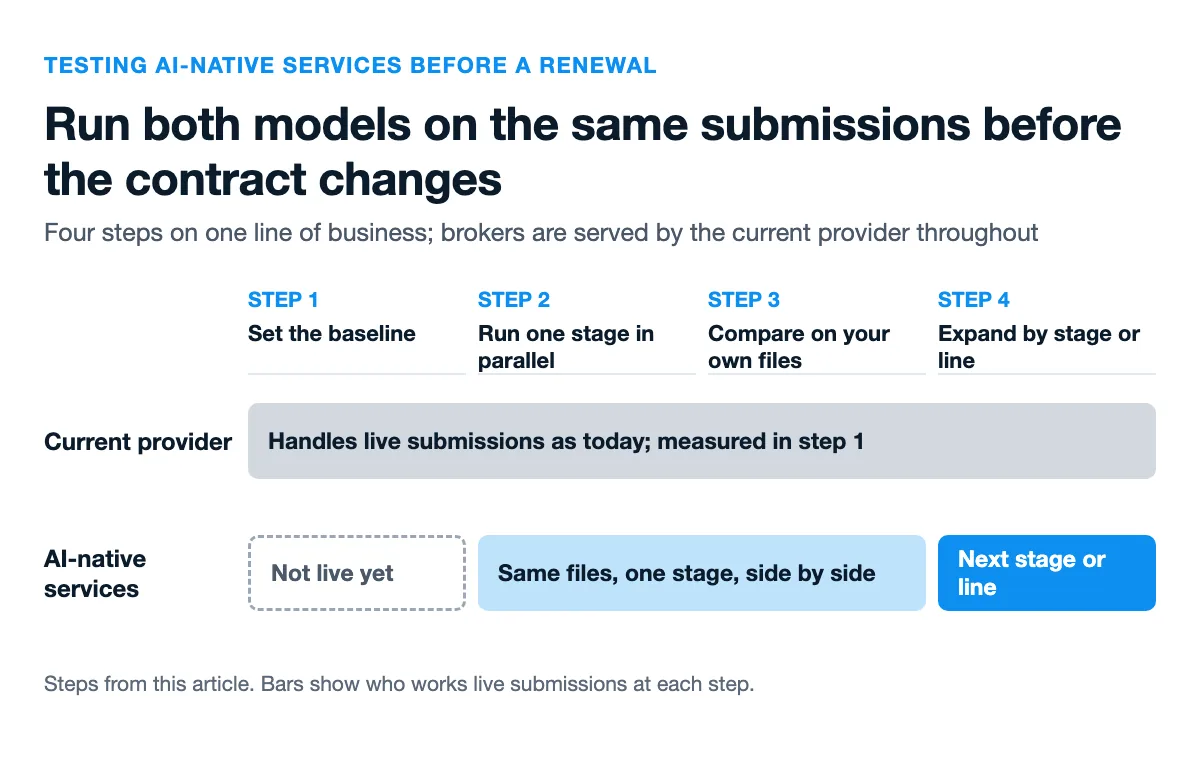
- Set the baseline. Measure error rate, turnaround and re-work on a recent sample of files from one line of business, using your own underwriters' corrections as the record of errors.
- Run one stage in parallel. Start with intake and clearance, or with extraction, on that one line, with the AI-native service working the same submissions as the current provider.
- Compare on your own files. Check accuracy field by field against the source documents, and compare turnaround from broker email to underwriter-ready file, including what happens when a revised document arrives.
- Expand by stage or by line. Move the next stage or the next line of business only when the first one meets its targets, and shape the renewal of the outsourcing contract around the work that remains.
This is the model behind Pibit AI's AI Underwriting OS, whose AI agents run underwriting from submission to quote so that your underwriters spend their time only on decisions and broker relationships. Buyers can choose one module or the full OS, run it inside the systems they already have, and in Verified mode they receive 99.9% workflow accuracy with our human-in-the-loop, guaranteed in the contract, with an SLA of 2 hours at most. A module goes live in a few weeks and the full OS in 1 to 2 months, with no implementation fee, which keeps the parallel test short enough to finish before a renewal date. Teams weighing an in-house build as a third route may also find our piece on build vs buy in underwriting automation useful before they decide.
Frequently Asked Questions

Insurance back office outsourcing is the use of an external provider to handle the administrative work behind underwriting, such as reading broker emails, clearing submissions, keying ACORD forms, loss runs and schedules into the policy admin system, chasing missing documents and preparing files for underwriters. It is often contracted as underwriting support services and priced by hours or by headcount.
In a BPO model people do the work and software supports them, with accuracy usually checked by sampling. In AI-native services, AI agents read every document first and insurance experts govern the result, so accuracy and turnaround can be committed in the contract and every extracted value can be traced to its source page. With Pibit AI's Verified mode, that commitment is 99.9% workflow accuracy with our human-in-the-loop and an SLA of 2 hours at most.
We suggest keeping the current provider in place while you test. Run one stage, such as intake and clearance or extraction, on one line of business in parallel, compare accuracy and turnaround on your own files, and expand only when the first stage meets its targets. With the AI Underwriting OS a module goes live in a few weeks, so the test can finish before most renewal dates.
Senior Underwriting Operations

Ready to optimize