Insurance document classification decides whether your submission data survives intake




- Submission data is won or lost at classification, one step before extraction, because a document labeled wrong is a field the system never reads.
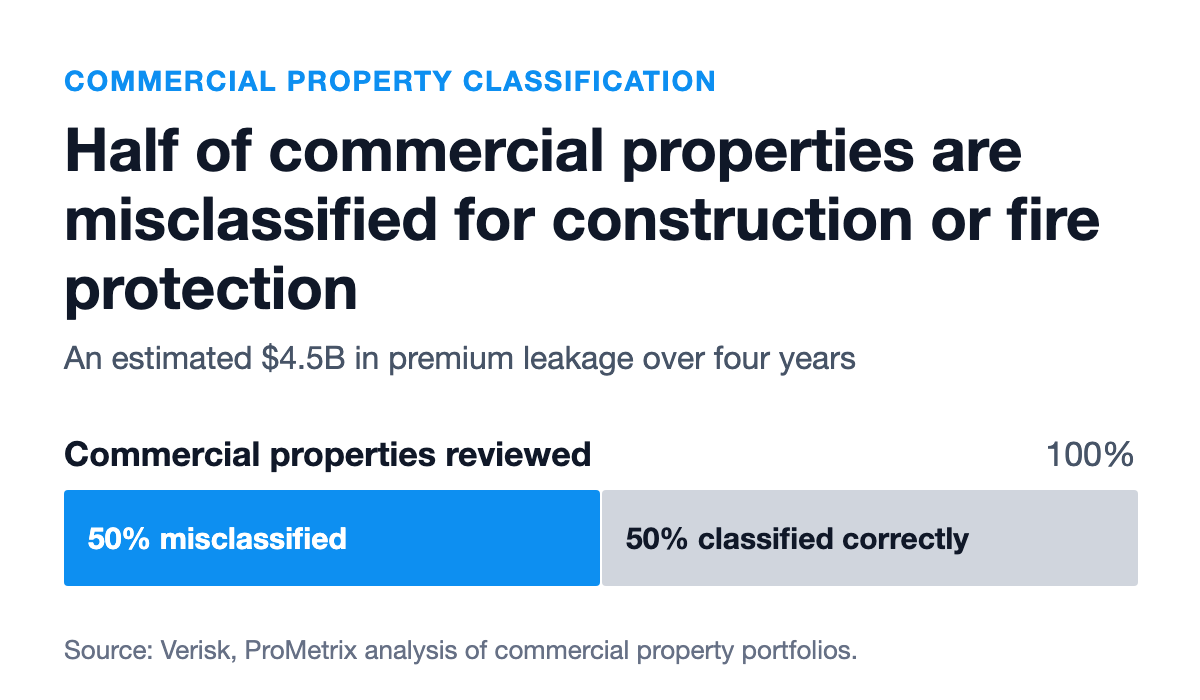
- According to a Verisk analysis, 50% of commercial properties are misclassified for construction or fire protection, an estimated $4.5B in premium leakage over four years.
- Generic OCR and IDP tools read layout and miss underwriting meaning, so they cannot reliably tell a loss run from a premium schedule.
- At scale, a 5% classification miss means thousands of mislabeled documents routed to the wrong logic or dropped.
- Near-perfect classification takes AI plus expert validation with confidence routing, and Pibit AI guarantees 99.9% field-level accuracy with our human-in-the-loop.
Insurance document classification is where submission data is won or lost, because a document the system labels wrong is a field it will never read, and even the best extraction model in the market returns nothing useful from a loss run it filed as a generic attachment. Most commercial carriers spend their AI budget on extraction accuracy and treat classification as plumbing, even though classification is the first step and decides whether extraction ever runs on the right page. In 2026, that first step is where margin leaks without anyone noticing, and very few teams measure it. The timing matters as well. According to AM Best's market segment report (February 2026), the US commercial lines combined ratio was 95.8 in 2025 and is projected at 96.3 for 2026, with rate growth plateauing across most lines. When margins thin and rate relief fades, the loss ratio has to be defended on the inputs, and classification is the cheapest input to fix.
What is insurance document classification?
Insurance document classification is the step that labels each file in a submission by type before any data is pulled, so that extraction can target the right fields. It decides that one attachment is an ACORD 125, another is a loss run, a third is a statement of values and a fourth is a driver schedule.
Classification sits between two steps that people often confuse with it:
- OCR turns pixels into characters.
- Extraction pulls named values from a known form.
- Classification is the judgment in between, which decides what a document is and which playbook applies to it.
When classification is skipped or wrong, the steps around it inherit the error. A submission usually arrives as a broker email with eight attachments and no labels, one PDF may hold three documents stapled together, and a spreadsheet may be named "AcmeCo final v4," so classification is the system deciding, page by page, what underwriting actually received. We cover that first mile in more detail in broker email submission extraction.
Why does a misclassified document mis-price the risk?
A misclassified document mis-prices the risk because it feeds the wrong facts, or no facts at all, into rating, and the clearest evidence for this sits in commercial property. According to a Verisk ProMetrix analysis of commercial portfolios, 50% of commercial properties are misclassified for construction class or fire protection, and Verisk put the resulting premium leakage at an estimated $4.5B over four years.
The mechanism is easy to trace. Construction class and protection class are rating variables, so if a statement of values is read as a generic spreadsheet, those fields never reach the rater cleanly, the account gets priced on defaults or on a broker's optimistic entry, and the premium is set below the true exposure until the gap surfaces at claim time. A number an underwriter owns makes the point clearer: a 2.5-point loss-ratio miss on a $400M book is $10M of underwriting margin, and misclassification hides inside that number one wrong label at a time. Our piece on the real cost of inaccurate underwriting data works through more examples.
Which documents must a commercial P&C intake classify?
A commercial P&C intake has to classify a wide and messy set of documents, often inside one email, and each type routes to different extraction logic and different rating fields.
| Document type | What it feeds | What a wrong label costs |
|---|---|---|
| ACORD 125 / 126 / 130 / 140 | Insured, exposure, and coverage basics | Core account fields default or go blank |
| Loss run | Claim history, frequency, severity | Prior losses missed, risk read as clean |
| Statement of values (SOV) | Location, construction, protection class | Property priced on wrong class, leakage |
| Driver / vehicle schedule | Units, radius, driver records | Fleet mis-rated, exposure undercounted |
| Supplemental application | LOB-specific risk questions | Appetite checks run on partial data |
| Certificate of insurance (COI) | Third-party coverage proof | Treated as an application, polluting data |
Volume compounds the problem, since a mid-market carrier can take tens of thousands of submissions a year, each with several attachments, and at that scale a 5% classification miss means thousands of mislabeled documents. Our guide to ACORD form processing software covers the most common of these forms.
Why do generic OCR and IDP tools misclassify insurance documents?
Generic OCR and IDP tools misclassify insurance documents because they read layout and have no model of underwriting meaning. A generic model sees a table of rows and numbers, and since a loss run and a premium schedule both look like tables, it cannot reliably tell one from the other.
Insurance documents defeat layout-only logic in three ways:
- Formats vary across hundreds of brokers, so no fixed template holds.
- Many files are hybrids, where a single PDF carries an ACORD form, a loss run and an email thread.
- The same word means different things by line, so "schedule" is a property SOV in one file and a driver list in another.
This is why insurance-native classification matters. A model trained on the document types underwriting actually handles reads the meaning of a page as well as its grid, and because it is template-agnostic by design, a format it has never seen still classifies correctly. We explain why the last few points of accuracy decide production readiness in why 95% AI extraction is not production ready.
How accurate does classification need to be, and how do you reach it?
Classification has to be near-perfect, because every downstream step inherits its error, and a 95% classifier that sounds strong will still send thousands of documents to the wrong logic, or drop them, at high submission volume. Accuracy at this step is the floor the rest of the system stands on.
Reaching that floor takes two things working together. AI does the first pass at machine speed and classifies the clear cases, and expert validation then reviews the low-confidence cases, so uncertain files get a human judgment before they move. Pibit AI runs this model through extraction and research and guarantees 99.9% field-level accuracy with our human-in-the-loop, written into the contract.
The design point is confidence routing. Sending every document to a person would be slow, and trusting the model blindly would be wrong, so the system routes by confidence and people spend time only where the machine is unsure, which lets speed and accuracy stop trading against each other.
How should a CUO evaluate document classification in an intake tool?
A CUO should evaluate classification on five questions before any demo of extraction, since most vendor conversations jump straight to extraction accuracy and never test the step that feeds it.
| Criterion | What good looks like | What should worry you |
|---|---|---|
| Template handling | Template-agnostic across new broker formats | Needs a template trained per format |
| Hybrid files | Splits multi-document PDFs page by page | Labels the whole file as one type |
| Accuracy guarantee | Contractual field-level accuracy with credits | A marketing percentage, no SLA |
| Exception handling | Low-confidence files routed to expert validation | Everything auto-posts, no human step |
| Auditability | Every label traceable to its source page | No record of why a file was labeled |
Classification is the quiet front door of underwriting. When it is fixed, clean data reaches the rater and the loss ratio is defended before an underwriter touches the account, while a carrier that leaves it to a generic reader pays for the gap in mispriced risk, one mislabeled document at a time. In an era of thinning margins, this is the step worth getting right first, and it is the starting point for any serious plan for submission intake automation or intake and clearance.
Frequently Asked Questions

Classification is a separate step. OCR turns images into text, and extraction pulls named values from a known form, while classification labels each file by type, such as ACORD, loss run or SOV. It decides which extraction logic runs, so an error here carries into every step after it.
It needs to be near-perfect, because every downstream step inherits the error, and a 95% classifier drops or misroutes thousands of documents at high submission volume. The practical path is AI for the clear cases plus expert validation for low-confidence files. Pibit AI guarantees 99.9% field-level accuracy with our human-in-the-loop.
A mislabeled document feeds wrong facts, or no facts, into rating. In commercial property, a Verisk analysis tied misclassification to an estimated $4.5B in premium leakage over four years. The account gets priced below its true exposure, and the gap surfaces at claim time inside the loss ratio.
Founding Member - AI

Featured blogs




Ready to optimize