AI-native underwriting: how it works and where it differs from bolt-on AI
.png)


- AI-native underwriting builds the whole submission-to-decision workflow around AI plus managed human review, instead of adding an AI feature to a process designed for manual keying.
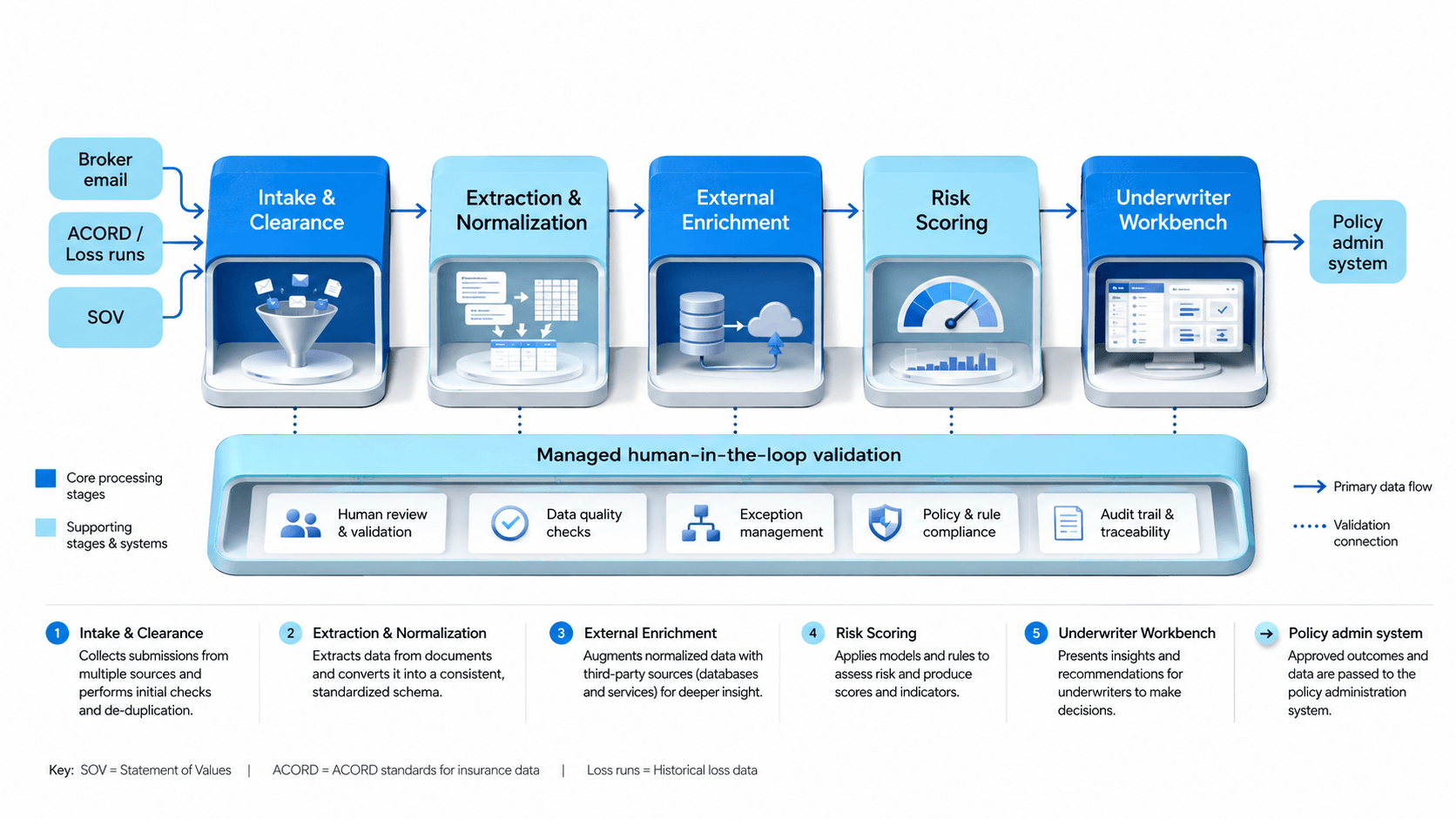
- The pipeline runs in five stages: intake and clearance, document extraction, external enrichment, risk scoring, and the underwriter workbench. Human-in-the-loop review sits inside the pipeline, not after it.
- The major difference from bolt-on AI is where the AI sits and what happens to a document format the model has never seen. Template-trained systems break on new formats; AI-native extraction normalizes them.
- The major difference from BPO is leverage. BPO cost scales linearly with volume. AI-native leverage improves as volume grows, because the model does the first pass and humans validate exceptions.
- Evaluate on the escalation rate and the accuracy mechanism, not the demo. Pibit.AI runs this as a managed service with 99.9% contractual field-level accuracy, sitting on top of the carrier's existing policy admin system.
AI-native underwriting is an approach where the intake, extraction, enrichment, and risk-scoring workflow is built around AI from the first step, with managed human review in the loop, rather than an AI feature bolted onto a workflow that was designed for manual data entry. The distinction sounds academic until you watch two carriers process the same messy submission. The AI-native platform turns a 200-tab schedule of values and a stack of carrier-specific loss runs into decision-ready data in hours. The bolt-on setup routes the same documents to a review queue, where a person still keys the hard fields by hand.
This piece is a working explanation, not a pitch. It covers what AI-native underwriting means, how the pipeline actually runs end to end, and the three architectures competing for the same budget: an AI-native platform, AI bolted onto a legacy workflow, and offshore business process outsourcing (BPO). If you are trying to tell the difference between them before signing anything, the mechanics below are the part that matters.
What does AI-native underwriting actually mean?
AI-native underwriting means the system was designed so that AI performs the first pass on every document and every submission, and the workflow, the data model, and the review process are all shaped around that fact.
The contrast is with software that was built for a manual process and later had an AI feature attached. A legacy underwriting workbench that adds an extraction button is still, underneath, a set of forms a person fills in. The AI is an assistant on the side. In an AI-native design, there is no manual-first path. The submission arrives, the model reads it, the data is structured, and a human validates the fields that need judgment. The default is machine-read; the exception is human-touched. That inversion is the whole idea, and it is why the future of commercial underwriting is described as an AI-native era rather than a feature upgrade.
Two clarifications, because the term gets stretched. AI-native does not mean fully automated. It also does not mean a single large language model doing everything. Serious AI-native underwriting is a set of specialized models, insurance-specific logic, and a managed review team working together. The point is not to remove the underwriter. It is to remove the keystrokes.
How does AI-native underwriting work, step by step?
The workflow runs as a pipeline. Each stage produces structured output that the next stage consumes. Here is the sequence for a commercial P&C submission.
- Intake and clearance. The system connects to the submissions inbox, reads the email body and every attachment, classifies each document (ACORD, loss run, SOV, supplemental, driver schedule), checks the submission against coded appetite rules, flags duplicates and renewals, and chases missing documents automatically. Out-of-appetite risks are declined or flagged before an underwriter ever opens them. This front-door step is where most carriers quietly lose premium to slow intake, because the broker has already placed the deal elsewhere by the time a human gets to it.
- Document extraction and normalization. The model pulls structured fields out of unstructured documents and maps them to one schema, regardless of which broker or carrier produced the file. This is the part template-trained OCR cannot do at scale, and it is worth understanding why: a template-trained system learns the layout of a specific form, so a new layout breaks it. Template-agnostic extraction reads the document by meaning, so a format it has never seen still normalizes correctly. Every extracted field carries provenance back to the source, which is the difference between an AI that shows its work and one you have to trust blind.
- External enrichment. Based on the line of business, the system pulls relevant third-party data: license-board verification for professional liability, safety and inspection records for commercial auto, hazard data for property. The application stays the ground truth. Enrichment adds context; it does not overwrite what the applicant submitted.
- Risk scoring. Extracted and enriched data feed a deterministic, factor-level score. Each factor is visible and individually weighted, scored as a positive, negative, or neutral signal, so an underwriter can see exactly which inputs moved the number and why. This is the opposite of a black-box model that returns a score with no explanation, and it is what makes a decision defensible under governance review.
- The underwriter workbench. Everything surfaces in one interface: the submission dashboard, the documents side by side, the AI summary, the risk signals, and the audit trail of what the AI extracted versus what a human edited. The underwriter spends time on judgment, not on data entry.
The step people miss is that human review lives inside stages two through four, not after them. A managed review team validates the extracted fields and the risk signals before the output reaches the carrier. That is how the accuracy guarantee is possible, and it is the mechanism a pure-AI point solution does not have.
How is AI-native underwriting different from bolt-on AI and BPO?
Three architectures are usually on the table. They look similar in a demo and behave very differently in production. The table below is the honest comparison.
The two differences that decide the outcome are format handling and leverage. A bolt-on system that depends on templates degrades every time a broker sends a slightly different form, and commercial submissions arrive in dozens of formats. A BPO arrangement is really just a faster spreadsheet: it works, but every additional submission costs another unit of human time, so the economics get worse as you grow, not better.
Why does the architecture change the result?
Because the constraint in commercial underwriting is not the decision, it is everything that has to happen before the decision. Underwriters are not slow. The data arriving at their desk is slow, incomplete, and inconsistent. When the first pass is manual, the whole line moves at the speed of keying, and adding AI on the side only speeds up the parts that were never the bottleneck. This is a large part of why AI's measured impact on underwriting has lagged other insurance functions: the AI was added to the wrong layer.
When the first pass is machine-read and humans validate exceptions, the line moves at the speed of the model, and human effort concentrates where judgment actually adds value. That is the operating leverage. In Pibit.AI's own client data, one workers' compensation MGA program processed 1,053 loss runs and 626 submissions in a single month with zero errors. The number that matters there is not the volume, it is that the underwriting team did not touch the review queue to get it.
How should you evaluate AI in underwriting?
Most evaluations over-index on the demo, which is the least informative moment because the vendor picked the documents. A better framework asks five questions about the architecture.
That framework is deliberately architecture-first, because the architecture is what you are actually buying. The details of how the pipeline is assembled, and how much of it you adopt, are where AI-native platforms differ most from each other, which is the subject of the agentic AI underwriting architecture breakdown.
Where does Pibit.AI fit here. Pibit is an AI-native, modular underwriting platform. The CURE platform is five modules: ClearCURE for intake and clearance, DocumentCURE for extraction and normalization, ResearchCURE for enrichment, RiskCURE for scoring, and WorkflowCURE for the underwriter workbench. Carriers adopt them a la carte, most starting with one or two, and the platform sits on top of existing policy admin systems such as Guidewire, Duck Creek, and Insurity rather than replacing them. Accuracy is 99.9% at the field level, committed contractually and backed by a managed review team, which is the reason the accuracy benchmark holds up over time instead of decaying after the pilot. Pricing is a subscription on submissions received, not on policies written.
None of that requires ripping out the systems already in place. That is the practical version of AI-native: the AI is at the center of the work, the underwriter is at the center of the decision, and the existing stack stays where it is.
Frequently Asked Questions

No. AI-native underwriting uses AI for the first pass on every document and submission, then routes fields that need judgment to a managed human review team. The design target is not straight-through processing; it is accurate, decision-ready data with a human validating exceptions. Pibit.AI commits to 99.9% field-level accuracy contractually, which is a different and more honest claim than fully automated.
No. A well-designed AI-native platform sits on top of the existing policy admin system and feeds it structured data. Pibit.AI integrates with systems such as Guidewire, Duck Creek, and Insurity through API, webhook, or direct submission creation, so there is no rip-and-replace. The AI-native layer changes how submissions are read and prepared, not the system of record.
The difference is where the AI sits and what the default path is. Bolt-on AI is a feature next to a manual workflow, so the process still defaults to human keying and the AI speeds up a few steps. An AI-native platform defaults to machine-read, with humans validating exceptions, and the data model, review process, and audit trail are all built around that. The clearest test is format handling: bolt-on systems tend to break on document formats they were not trained on, while AI-native extraction normalizes new formats by meaning.
AI & Underwriting Specialist


.png)


Ready to optimize